
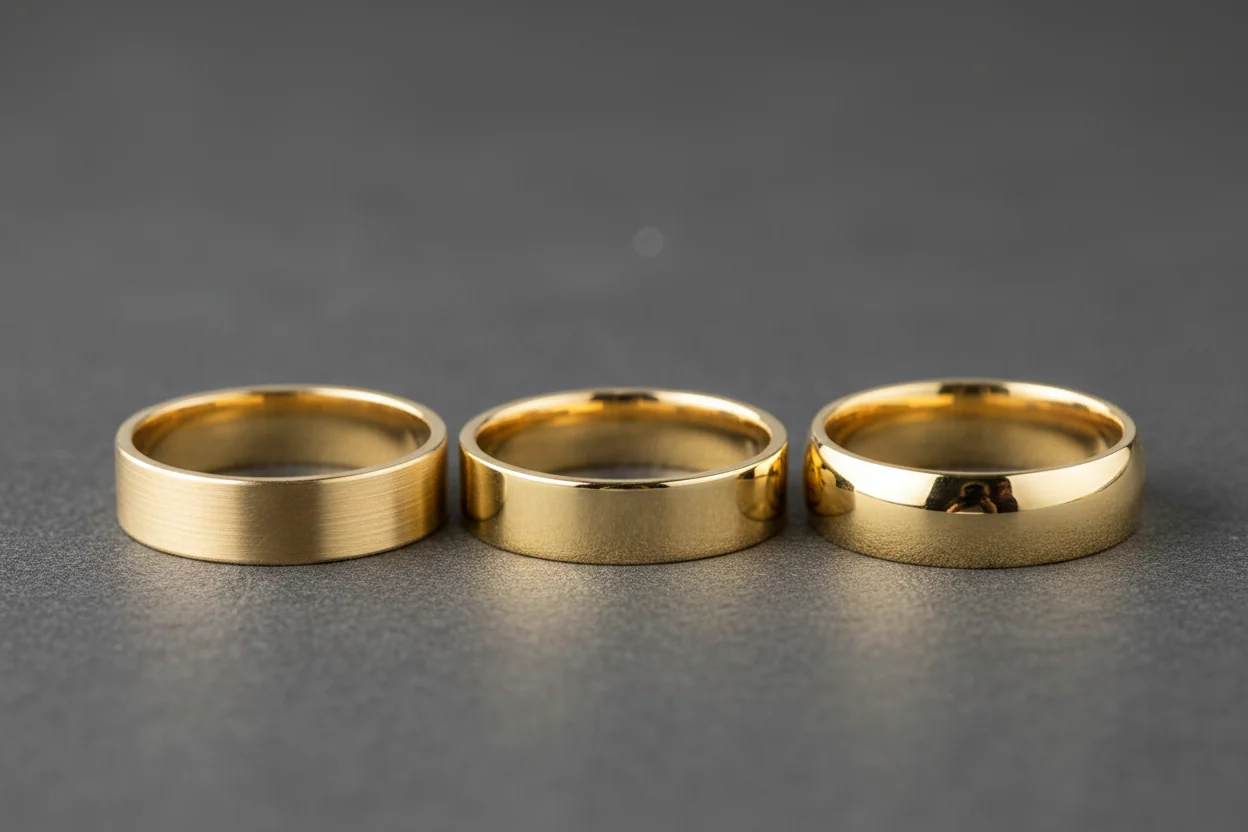
A tray of men’s wedding bands can look surprisingly uniform from above. Slide one onto a finger, though, and the differences quickly become physical. The edge may press against the next finger, the inside might glide over the knuckle, or a broad strip of polish may catch your eye every time you move. Those effects come from three related choices: the profile, width and finish of the ring. It helps to try each in isolation before deciding how to combine them.
The best sample rings let you compare those differences without first changing everything at once. If you are exploring men’s wedding band styles, ask the jeweller to show you sample bands with clear differences. Trying them in a sequence makes it easier to work out what you are noticing.
Start with the inner and outer profiles
Look at the end view of the band. The outside may be rounded, flat or shaped with sloping edges. A gently curved face gives a soft highlight, while a flat face makes the width easier to see. A bevel can define the edge without giving the whole band a rounded appearance. Turn your hand over as well. You may see much more of the underside of a ring when reaching or holding an object.
Ask how the inside is shaped. Some bands have a curved interior that reduces the amount of edge you feel as the ring moves. Try a sample over the knuckle and check how it sits at the base. Ask the jeweller to size you for the profile you intend to buy.
Use width to tune the weight and appearance
Try a narrow band and a noticeably wider one in the same material. Width influences the visual weight of the ring and can change how tightly it feels. Thickness and metal also affect the weight you feel, so ask for both measurements when comparing models. A broad, thin ring may feel different from a narrow band with a substantial cross section.
Clench and relax your hand with each sample. If you wear a ring on an adjacent finger, try it at the same time. Look for enough space to close your fingers naturally. Decide how much of your finger you want the ring to cover from above, then make sure the width you like also feels right during movement.
Pick a finish you can live with as it changes
A polished band gives clean reflections and can show fine marks as it wears. Brushing gives the surface a direction and a more diffuse reflection. Hammered finishes break the surface into smaller areas that catch light individually. Run through those options in daylight if possible. A showroom spotlight can make small contrasts look much sharper.
Ask the maker how it would restore the finish and whether any decoration affects sizing. If you like mixed finishes, check how clearly you can see the boundary between them. A narrow polished bevel on a brushed ring may give just enough definition without making the main surface bright.
Final Thought
Work out which profile feels most natural, then compare widths within that shape. Save the finish for a final viewing in ordinary light. You will be judging the surface on a band that already fits the way you want to wear it.